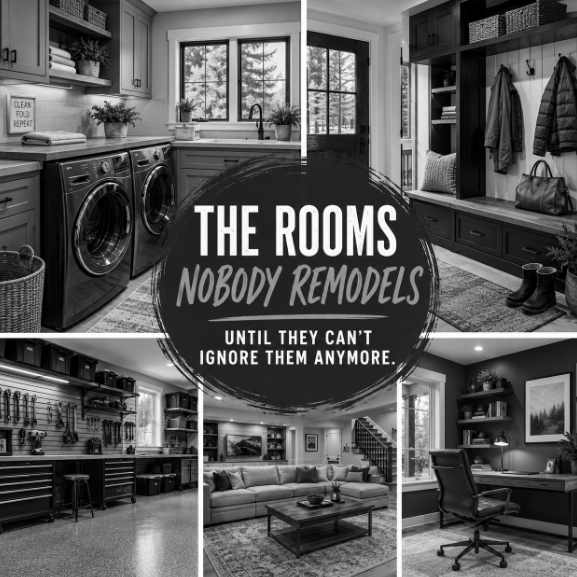
The Rooms Nobody Remodels — Until They Can’t Ignore Them Anymore
Everyone talks about kitchens. Everyone talks about bathrooms.
And for good reason — those are the rooms that usually get the attention. They affect resale value, they photograph well, and they’re the projects people imagine when they think about remodeling.
But there’s another category of spaces that quietly make daily life harder.
The rooms you work around every single day.
The spaces that frustrate you in small ways so often you almost stop noticing them.
The rooms that have been “fine for now” for years.
Until suddenly they aren’t.
Laundry Room Remodel Ideas That Actually Improve Daily Life
Most laundry rooms in North Idaho homes were never really designed for the people using them.
You’ve got one dim light overhead. No place to fold clothes. Shelving that never made sense. Old vinyl flooring that’s peeling at the corners or impossible to get fully clean anymore. Sometimes the washer and dryer are squeezed into a hallway or tucked next to a garage entry with zero usable storage nearby.
And yet people spend hours in these spaces every week.
Laundry rooms rarely make the top of the remodeling list because they don’t feel exciting. But function matters. A laundry room with better lighting, durable flooring, storage that actually works, and a real folding surface changes the experience of using the space every single day.
It’s one of the highest-function upgrades you can make in a home without taking on a full kitchen-level remodel.
Mudroom & Entryway Remodeling That Stops the Chaos
Your entryway sets the tone for the entire house.
And in most homes we walk into, it’s carrying way more responsibility than it was built for.
Shoes piled by the door. Wet jackets with nowhere to go. Kids’ backpacks stacked in corners. One small coat hook trying to handle an entire family during a North Idaho winter.
When you’re dealing with snow, mud, rain, boots, dogs, and cold weather for half the year, a functional entryway matters more than people realize.
Built-in benches. Durable flooring. Storage underneath seating. Enough hooks for actual daily life. Better lighting. A place for wet gear that keeps it from spreading across the house.
Small changes in an entryway can make the entire home feel more organized because the mess gets stopped at the door instead of moving through the rest of the house.
That’s a big quality-of-life upgrade from a relatively small space.
Finishing an Unfinished Basement
We see this all the time.
A basement that got halfway finished years ago. Some framing went up. Maybe drywall got hung. Maybe somebody painted the concrete floor and planned to come back later.
Then life happened.
Now the basement sits in that awkward middle ground where it’s technically usable, but nobody actually wants to spend time down there.
The thing is, most partially finished basements are closer to complete than homeowners think.
Usually it’s a handful of things keeping the space from feeling finished:
Proper flooring
Trim work
Better lighting
Ceiling finishing
A bathroom that was always planned but never added
Storage solutions that make the space functional instead of temporary
We’ve seen homeowners avoid using thousands of square feet for years because the project felt overwhelming, when in reality the remaining work was manageable once it was broken into steps.
And in North Idaho, where people spend a lot of time indoors during winter, having comfortable usable basement space changes how the entire home functions.
Garage Remodel Upgrades That Make the Space Usable Again
The garage is where organization usually falls apart.
Tools with no real home. Storage piled against walls. Poor lighting. Cracked concrete. Random shelving installed over the years that never really worked together.
Eventually the garage becomes a space people avoid using altogether — which is why so many vehicles end up sitting outside through winter while the garage fills up with clutter.
Most homeowners don’t need a luxury showroom garage.
They just need a garage that works.
A solid workbench at the right height. Wall storage that makes sense. Better lighting. Shelving designed around the things you actually use. Floor coatings that make cleanup easier and brighten the space up.
Simple functional upgrades can completely change how a garage gets used without turning it into some overbuilt Pinterest project.
Home Office Remodeling for Remote Work
Remote work isn’t going anywhere.
But a lot of home offices still feel like temporary setups that accidentally became permanent.
A desk shoved into a guest room. A hallway corner with bad lighting. Power strips everywhere because the room never had enough outlets. No sound separation. No storage. No real ability to shut work off at the end of the day.
A functional home office doesn’t need to be huge. It just needs to be intentional.
Good lighting matters more than people expect. So does outlet placement. Storage. Sound control. A door that actually closes when you’re on calls or trying to focus.
For people working from home full-time or even part-time, the setup affects productivity, stress levels, and the ability to separate work life from home life.
That’s not a luxury upgrade anymore. It’s practical.
The Mr. Clean Fix Take
The rooms people ignore are often the ones affecting daily life the most.
Not because they’re glamorous.
Usually they aren’t.
But because they’re the spaces you interact with constantly — the ones where small frustrations add up over time until the house starts feeling harder to live in than it should.
We think every room in a home deserves to function well, not just the ones that end up in renovation magazines.
Sometimes a small functional remodel improves daily life more than a major renovation ever could.
If you’ve got a space that’s been getting by for years — a laundry room, basement, garage, entryway, or home office — we’re happy to take a look and talk through what it would realistically take to make it work better.
Because you don’t always need to remodel the biggest room in the house.
Sometimes you just need to fix the room that frustrates you every day.

Project Spotlight: It Started With a Cat Window — A Year Later, The Whole Front of the House Is Done
It started with one oversized picture window — and a couple of cats who refused to leave that sunny spot.
We installed it last spring, featured it in a blog, and moved on to the next job. Good project. Happy homeowners. Done.
Except it wasn't done.
Fast forward almost exactly one year. The homeowners came back. Turns out that one window changed how the whole front of the house looked — and now the other seven were impossible to ignore.
That's how one good project turns into a relationship. And honestly? It's one of our favorite things about this work.
Seven Custom Windows — Inside and Out
These weren't stock windows pulled off a shelf. Custom ordered, built to fit, and finished to match the character of the home on both sides of the wall.
Exterior work included installing all seven units and painting the trim clean and sharp. Simple in description. Not always simple in execution — especially when the homes here in North Idaho have weathered a few seasons and the trim tells that story.
Inside was where it got more detailed. The existing trim was wood that needed staining — not painting. Stain is unforgiving. It shows every flaw, every rushed moment, every shortcut. You don't fake your way through a good stain job.
We took our time. The finished product shows it.
One Window Came In Defective. Here's What We Did.
This is the part of the job that didn't go according to plan.
One of the seven windows arrived defective. It wasn't visible at pickup — those things rarely are until you're mid-install and the light catches it just right. The moment we identified it, we got a warranty claim moving and a replacement shipped.
The other six were completed in mid-March.
The seventh — the right one — went in this past Saturday.
This is where timelines slip and shortcuts happen for some crews. We don't do either. The homeowner deserved a complete, correct job. So we communicated, we waited, and we finished it right.
Every window. Done correctly. That's not extra — that's just the standard.
The Guest Room: Four Colors, Chair Rail, Wainscoting, and Oil-Based Paint
While the windows were underway the homeowners had one more ask — the guest room needed painting.
This room had a chair rail and wainscoting, which meant four distinct colors had to work together across different surfaces without looking like a mistake.
Then we found out the paint was oil-based.
Oil-based means longer dry times, more coats, and a slower process overall — but the finish is worth it when it's done right. You don't rush it. You don't cut corners on dry time. You just do the work.
The result is a guest room with clean transitions at every line, the wainscoting and chair rail landing exactly where they should, and four colors that feel intentional instead of chaotic.
The homeowners were thrilled. That's the part that makes the extra hours worth it every time.
One Year. Two Projects. One Home That's Finally Done Right.
A single picture window last spring. Seven more this spring. A guest room that finally got the attention it deserved. A defective window handled without drama and finished without shortcuts.
That's what a real contractor relationship looks like over time.
We don't show up, do a job, and disappear. We come back. We finish things right. And we're still here when the next project is ready.
If you're looking at your front windows right now thinking "it's probably time" — you're probably right. We're happy to walk it with you.
Because when it's done right the first time, it's never the last project.
The Kitchen Triangle Is Dead. Here's What Actually Matters Now.
Kitchen Reality Check — Part 1 of 3
This is Part 1 of our Kitchen Reality Check series — three blogs breaking down what actually makes a kitchen work, from a contractor who's seen the good, the bad, and the "why did anyone think that was a good idea."
For decades, kitchen design lived and died by one rule.
The kitchen triangle — the invisible line connecting your sink, stove, and refrigerator — was supposed to be the golden formula for a functional kitchen. Keep those three points close, keep traffic out, boom. Efficient kitchen.
It made sense. In 1948.
The problem? Nobody told your kitchen it was living in 2026.
At Mr. Clean Fix, we've remodeled a lot of kitchens across North Idaho. And we can tell you firsthand — the triangle isn't what's making people's kitchens fail. It's that nobody designed them around how the family actually lives in them.
That's the real conversation. So let's have it.
Why the Triangle Stopped Working
The triangle was built for one cook, one task, one small closed-off room. That was the kitchen of mid-century America.
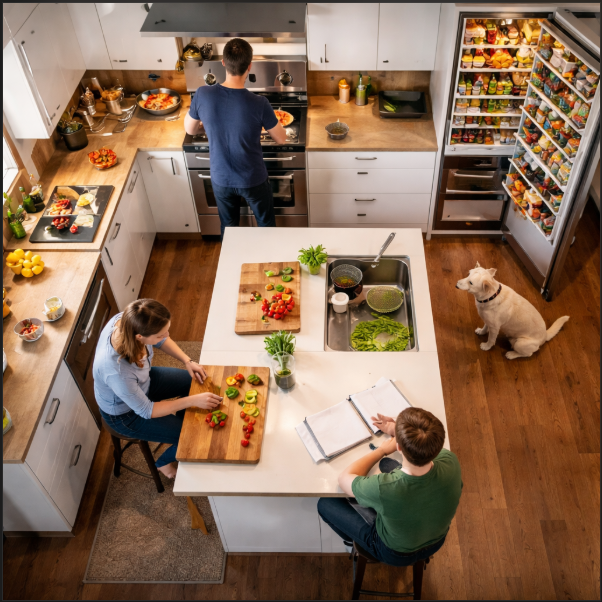
Today's kitchens are open. They're loud. They've got two people cooking, a kid doing homework, someone digging through the fridge, and a dog parked right where you need to stand — all at the same time.
A three-point triangle doesn't solve any of that. Not even close.
What Actually Works: Zones
Around here in North Idaho, most kitchens we walk into were built for a different era and a different family. When zones are laid out right, everything just works. When they're not — you feel it every single night.
A zone is a dedicated area for a specific task. Here's what a well-designed kitchen actually looks like:
The Prep Zone — Where the real work happens. Counter space, cutting board, easy access to tools, close to the sink. If you're walking across the kitchen every time you need to rinse something, this zone is broken.
The Cooking Zone — Your range and everything that belongs with it. Spices, oils, pots and pans within arm's reach. Not across the room. Not in a lower cabinet you have to dig through while something's boiling over.
The Cleanup Zone — Sink and dishwasher. These two should always be next to each other. Always. We still walk into kitchens where they're separated and wonder what the original designer was thinking.
The Consumables Zone — Fridge and pantry. Ideally accessible from the edge of the kitchen so someone can grab a snack without walking through the middle of everything and derailing whoever's cooking.
The Non-Cook Zone — This one's underrated and most kitchens don't have it. A spot where people can hang out, help with homework, pour a drink — without being in the way. A well-placed island with seating usually handles this. A poorly placed one makes it worse.
Let's Talk Islands — Honestly
Almost every kitchen remodel conversation gets to the island eventually. And we love islands. But only when they actually make sense.
We've also seen plenty that had no business being where they were — crammed into spaces too small, blocking traffic, creating a pinch point that makes the kitchen harder to use than before. That's not an upgrade. That's an obstacle with a countertop.
Before committing to an island, answer these honestly:
Is there at least 42 inches of clearance on every side? 48 is better.
Does it add real counter space and storage — or just eat up floor space?
Does it create that non-cook zone, or does it just push everyone into the same tight path?
If it doesn't improve how you actually move through the kitchen on a busy Tuesday night, it's not worth it.
Most "Storage Problems" Aren't Storage Problems
This comes up constantly. Homeowners feel like they don't have enough storage — so they want more cabinets, more drawers, more pull-outs.
Sometimes that's true. But more often? It's a layout problem wearing a storage costume.
Your pots live across the kitchen from your stove. Your spices are in a cabinet behind you while you're cooking. Your prep area is nowhere near your most-used tools. That's not a storage issue — that's everything living in the wrong place.
Fix the layout first. Then see how much storage you actually still need.
The Honest Contractor Take
No formula replaces a real conversation about how you actually cook and live.
Before we ever talk cabinets or countertops or finishes, we want to know: what drives you crazy about your kitchen right now? Where does it break down? What works?
Those answers tell us more about the right design than any rule ever will.
Because a kitchen that looks incredible in photos but fights you every night isn't a win. A kitchen that just works — for your family, your routine, your real life — that's the goal.
If it doesn't work on a busy Tuesday night, it's not a good kitchen. Period.
That's what we design for. Every time.
Next up in the Kitchen Reality Check series: the 5 kitchen layout mistakes we see over and over in North Idaho homes — and how to avoid every single one of them. Publishing next Friday.

Lighting Matters: How the Right Light Can Change the Entire Home
Lighting is one of the most underestimated elements in a home—and one of the most powerful. You can have beautiful flooring, perfectly painted walls, and high-end finishes, but if the lighting is off, the entire space can feel… wrong. On the flip side, the right lighting can elevate even the simplest room into something warm, inviting, and intentional.
At its core, lighting isn’t just functional—it’s emotional. It shapes how a space feels, how it’s used, and even how you experience your home day to day.
The Mood Maker You Didn’t Know You Needed
Lighting directly impacts mood. Bright, cool-toned lighting can make a space feel energetic and productive—great for kitchens, bathrooms, and workspaces. Warmer, softer lighting creates a relaxed, cozy atmosphere, perfect for living rooms and bedrooms.
Ever walked into a room and instantly felt at ease? Or the opposite—harsh lighting that makes everything feel sterile? That’s not an accident. That’s lighting doing its job (or failing to).
Layers Are Everything
One overhead light in the center of a room just doesn’t cut it anymore. Thoughtful lighting design uses layers:
Ambient lighting: The main source of light (ceiling fixtures, recessed lighting)
Task lighting: Focused lighting for specific activities (under-cabinet lights, desk lamps)
Accent lighting: Highlights architectural features or decor (wall sconces, LED strips)
When these layers work together, the room feels dynamic and balanced instead of flat and one-dimensional.
Lighting Can Change Perception of Space
Want a room to feel bigger? Brighter lighting and strategically placed fixtures can open it up.
Need to make a large space feel more intimate? Lower, warmer lighting brings everything back down to a human scale.
Even ceiling height can feel different depending on how light is directed. Uplighting can make ceilings feel higher, while downward lighting creates a more grounded, cozy feel.
Color Temperature Matters More Than You Think
Not all light is created equal. The “temperature” of a bulb—measured in Kelvins—affects how colors appear and how a room feels:
2700K–3000K: Warm, soft, inviting (ideal for living spaces)
3500K–4000K: Neutral, balanced (great for kitchens and bathrooms)
5000K+: Cool, bright daylight (best for garages or work areas)
Choosing the wrong temperature can make your beautiful finishes look dull, washed out, or overly harsh.
Highlighting What Matters
Good lighting doesn’t just illuminate a space—it tells you where to look.
A well-placed pendant light draws attention to a kitchen island.
Under-cabinet lighting showcases a backsplash.
Accent lighting can turn a simple wall into a feature.
It’s about guiding the eye and creating subtle focal points throughout the home.
Energy Efficiency Meets Style
Modern lighting solutions don’t just look better—they perform better too. LED technology offers longer lifespan, lower energy use, and more flexibility in color and brightness.
That means you can have beautiful, customized lighting without sacrificing efficiency.
The Takeaway
Lighting isn’t just a finishing touch—it’s a foundation. It has the power to completely transform how your home looks, feels, and functions.
If your space feels off and you can’t quite figure out why, take a look up. The answer might not be in your walls or floors—it might be in the light above them.
Because when lighting is done right, everything else falls into place.
The Art of Multifunctional Living: Making Every Room Work Smarter
In today’s homes, space isn’t just about square footage—it’s about how well that space works for you. Whether you're navigating a busy household, working from home, or simply wanting more flexibility, multifunctional living is quickly becoming the gold standard in modern design.
At Mr. Clean Fix, we’ve seen firsthand how transforming a single-purpose room into a dual-function space can completely change how a home feels and functions. It’s not just about saving space—it’s about creating a home that adapts to your life.
Why Multifunctional Spaces Matter
Life doesn’t fit neatly into one box—so why should your rooms?
The dining room that sits unused most of the week, the guest room that only sees visitors twice a year, or the basement that’s become a catch-all storage zone… these are all opportunities waiting to happen.
Multifunctional design allows you to:
Maximize every square foot
Adapt your home to changing needs
Reduce clutter and increase efficiency
Create a more intentional, organized living environment
Popular Double-Duty Room Ideas
1. Home Office + Guest Room
With more people working remotely, this is one of the most in-demand combinations. Think murphy beds, sleeper sofas, or built-in desks that don’t compromise comfort when guests arrive.
2. Living Room + Playroom
Instead of toys taking over the entire house, create a designated (but stylish) play area within your main living space. Built-ins, hidden storage, and durable finishes make all the difference.
3. Kitchen + Command Center
A small nook with a desk, charging station, and calendar board can turn your kitchen into the hub of the home—perfect for managing schedules, homework, and daily life.
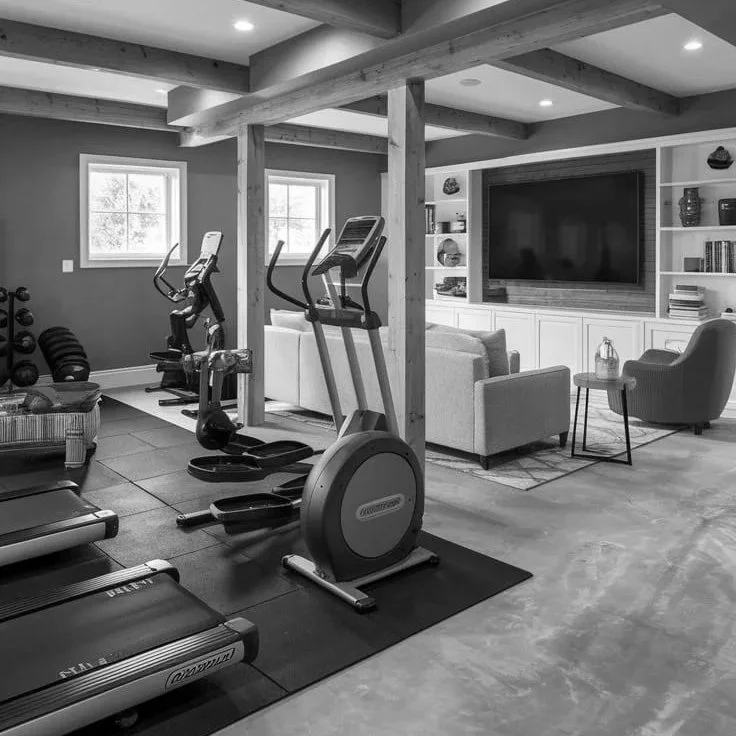
4. Basement + Fitness Space
Your basement doesn’t have to be just storage. We can help turn it into a hybrid space—part gym, part lounge, part entertainment zone.
5. Bedroom + Workspace
Even in smaller homes, we can design a layout that allows for productivity without sacrificing rest and relaxation.
Design Tips for Multifunctional Living
Making a room do double duty takes more than just placing two functions in the same space—it requires thoughtful design.
Zoning is key: Use rugs, lighting, or partial walls to define different areas within one room.
Built-ins are your best friend: Custom shelving, desks, and storage solutions keep everything seamless and clutter-free.
Furniture should work harder: Look for foldable, expandable, or hidden-function pieces.
Keep flow in mind: The space should feel natural, not cramped or chaotic.
How Mr. Clean Fix Can Help
This is where we come in.
At Mr. Clean Fix, we specialize in turning “what if” spaces into “why didn’t we do this sooner?” transformations. Whether it’s reframing a layout, adding built-ins, finishing a basement, or creating custom solutions, we help homeowners unlock the full potential of their space.
We don’t believe in one-size-fits-all designs. Every home—and every lifestyle—is different. That’s why we work closely with you to understand how you live, what you need, and how your space can support that.
Your Home, Reimagined
Multifunctional living isn’t just a trend—it’s a smarter way to live. It’s about making your home flexible, efficient, and ready for whatever life throws your way.
If you’ve got a room that isn’t pulling its weight, it might be time to rethink it.
Let’s turn your space into something that truly works for you.

Open Concept vs. Defined Spaces: What’s Right for Today’s Homes?
For years, open concept living has dominated home design. Walls came down, kitchens flowed into living rooms, and entertaining became easier than ever. But recently, homeowners have started reconsidering the idea that bigger and more open is always better.
Now we’re seeing a shift toward defined spaces—rooms with clearer purpose, better sound separation, and more privacy.
So which one is right for your home?
The answer isn’t one-size-fits-all. It depends on how you live in your space. The good news? Mr. Clean Fix can help homeowners move in either direction, whether that means opening things up or creating more functional separation.
Let’s take a look at both styles.
The Appeal of Open Concept Living
Open concept homes remove walls between major living areas, typically connecting the kitchen, dining room, and living room into one large shared space.
Why homeowners love it
• Better for entertaining – Everyone stays connected during gatherings.
• More natural light – Light travels through the entire space instead of being blocked by walls.
• Feels larger – Even modest homes feel bigger when sightlines open up.
• Modern look – Clean lines and spacious layouts still appeal to many buyers.
For families who enjoy hosting, cooking together, or keeping an eye on kids while working in the kitchen, open layouts can make daily life feel more connected.
How Mr. Clean Fix helps
If you're considering opening up your home, we can help with:
• Non-load-bearing wall removal
• Structural modifications when load-bearing walls are involved
• Kitchen remodels that integrate into living areas
• Flooring continuity throughout the open space
• Lighting upgrades to match the new layout
Opening a space properly requires planning, structural knowledge, and finishing work that makes the change feel seamless—and that’s exactly where our experience comes in.
The Return of Defined Spaces
While open concept homes are still popular, many homeowners are rediscovering the value of separate rooms.
After years of remote work, online school, and busy households, people are realizing that sometimes walls are actually useful.
Why defined spaces are making a comeback
• Noise control – Separate rooms reduce distractions.
• Work-from-home privacy – Dedicated offices are easier to focus in.
• Energy efficiency – Smaller rooms are easier to heat and cool.
• More design personality – Each room can have its own character.
Defined spaces can make a home feel more organized and functional, especially for families who need different areas for work, relaxation, and entertainment.
How Mr. Clean Fix can help
If your home feels too open, we can help create structure with:
• Framing new interior walls
• Adding offices, reading rooms, or flex spaces
• Installing sliding barn doors or pocket doors
• Creating mudrooms or entry partitions
• Custom trim and finish work to match your home's style
Sometimes even small layout changes can dramatically improve how a home functions.
Finding the Right Balance
Many modern homes are finding a middle ground between open and defined spaces.
Instead of completely open layouts, homeowners are using design elements like:
• Partial walls
• Archways
• Built-in shelving dividers
• Kitchen islands
• Glass-paneled doors
These features maintain openness while still giving rooms a sense of purpose.
Making Your Home Work for You
The most important question isn’t whether open concept or defined spaces are trending.
It’s how you actually live in your home.
Do you host often?
Need quiet work areas?
Want better flow between rooms?
Every home—and every family—is different.
At Mr. Clean Fix, we help homeowners rethink their spaces so they function better for everyday life. Whether that means opening up walls, creating new rooms, or finding the perfect balance between the two, we’re here to make it happen.
Thinking about updating your home's layout?
Let’s talk about your ideas and how we can bring them to life.
Mr. Clean Fix
Helping North Idaho homeowners create spaces that truly work for them.

Holiday Kitchen Quick Fixes: Simple Upgrades That Make a Big Impact
Your kitchen is about to become the busiest room in the house — but it doesn’t have to feel like a construction zone. Small, strategic updates can make your kitchen shine just in time for the holidays. Whether you’re baking pies, hosting guests, or just want to impress your in-laws, here are five upgrades that give maximum impact with minimal downtime.
1) Swap Hardware, Not Cabinets
New knobs and pulls = instant facelift. Try brushed brass or matte black for a modern look that complements most cabinet colors.
2) Brighten the Space
Under-cabinet lighting or new LED bulbs in warm tones make a kitchen feel cleaner, larger, and ready for holiday cooking.
3) Fresh Backsplash
Peel-and-stick tile or a small section of decorative tile can completely change your kitchen’s personality — perfect for adding a festive touch.
4) Countertop Touch-Up
If replacement isn’t in the plan, consider refinishing kits or adding a butcher-block section. Even a small workspace upgrade makes prep easier.
5) Add Character with Open Shelving
Swap one upper cabinet for floating shelves to display dishes or holiday décor — a modern touch that also opens the room visually.
Call to Action
Before the holiday cooking marathon starts, give your kitchen a refresh that works as hard as you do.
Schedule your free consultation with Mr. Clean Fix — we’ll help you make smart updates that fit your time and budget.