How to Budget for a Remodel Without the Stress
Let’s be honest.
Budgeting for a remodel can feel overwhelming. Numbers everywhere. Pinterest inspiration that keeps growing. Surprises hiding behind drywall. And that little voice that whispers, “What if we can’t afford this?”
At Mr. Clean Fix, we’ve seen it time and time again — the stress doesn’t usually come from the remodel itself.
It comes from not having a clear plan.
Here’s how to budget for your remodel the smart way… without losing sleep over it.
1. Start With Your “Why” (Not the Numbers)
Before you crunch a single number, ask yourself:
Are we remodeling to increase home value?
Improve function?
Fix something failing?
Or create a space we actually love being in?
Your “why” determines your spending strategy.
If you're remodeling to sell, you may focus on ROI.
If you’re remodeling to stay, comfort and quality might matter more than short-term resale value.
Clarity reduces stress. Every time.
2. Set a Realistic Range — Not a Perfect Number
One of the biggest stress triggers is locking yourself into a hard number too early.
Instead, create:
A comfortable range
A ceiling number you absolutely won’t exceed
Example:
“We’d like to stay around $25k, but we’re comfortable up to $30k if it truly improves the project.”
Ranges give breathing room.
Breathing room lowers anxiety.
3. Break the Budget Into Categories
Instead of looking at one big scary number, break it down:
Labor
Materials
Fixtures
Finishes
Permits
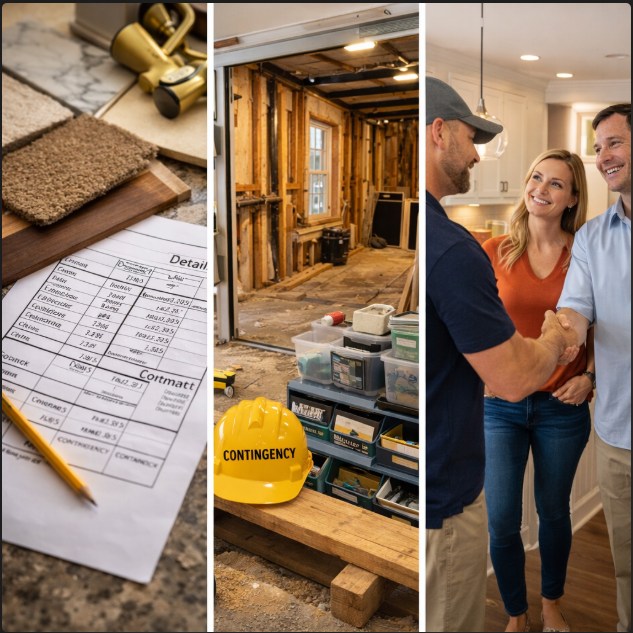
Contingency
When clients see how a remodel is built piece by piece, it stops feeling mysterious — and starts feeling manageable.
Transparency removes fear.
4. Always Plan for a Contingency
We say this with love:
If you don’t plan for surprises… they will plan for you.
In remodeling, especially in older homes, there are unknowns behind walls.
Industry standard recommendation:
10% contingency for newer homes
15–20% for older homes
If you don’t use it? Great.
If you need it? You’re calm instead of scrambling.
That’s the difference.
5. Decide Where to Splurge and Where to Save
Every project has “anchor items” — the pieces that matter most.
In a kitchen, that might be:
Cabinets
Countertops
Appliances
You can save on:
Lighting upgrades later
Decorative hardware
Some finish selections
Choose 2–3 elements to prioritize.
Be flexible on the rest.
Stress usually comes from trying to max out everything.
6. Phase It If Needed
Not everything has to happen at once.
If budget feels tight:
Complete structural or functional work first
Upgrade finishes later
Spread projects over seasons
A phased plan is still a plan.
And a plan is power.
7. Work With a Contractor Who Talks Numbers Clearly
A good contractor won’t avoid money conversations.
They’ll:
Explain labor vs material costs
Help you adjust selections to stay within range
Offer options without pressure
Communicate when changes affect pricing
Remodel stress often isn’t about cost — it’s about uncertainty.
Clear communication eliminates that.
8. Focus on Long-Term Value, Not Just Price
Cheaper isn’t always less stressful.
Redoing something twice?
Very stressful.
Paying for quality work that lasts?
Peace of mind.
A remodel should improve your daily life — not create financial regret.
Final Thought
Budgeting doesn’t have to be intimidating.
It’s just a roadmap.
And like any good roadmap, it works best when:
You know your destination
You understand the terrain
And you have the right team guiding you
If you're considering a remodel and want real numbers without pressure or confusion — we’re always happy to walk through it with you.
Clear plan. Clear communication. No chaos.

Remodel Now or Wait? How to Know When It’s Time to Invest in Your Home
One of the most common questions we hear is this:
“Should we remodel now… or wait?”
It’s a fair question. Remodeling is an investment — financially, emotionally, and logistically. And timing matters.
But here’s the truth most homeowners don’t realize:
The right time isn’t just about the market.
It’s about your life.
Let’s break this down in a way that actually helps you decide.
Market Timing vs. Personal Timing
Everyone wants to “time it right.”
Interest rates.
Material costs.
Housing values.
Economic headlines.
Yes — those things matter.
But market timing only tells part of the story.
Market Timing
If:
Home values are strong
Inventory is low
You plan to sell in the near future
Strategic updates can increase resale appeal and ROI.
On the flip side, waiting for the “perfect” market moment can keep you stuck for years. Materials fluctuate. Labor fluctuates. Rates fluctuate. There is rarely a magical window where everything aligns perfectly.
Personal Timing (The One That Matters More)
Ask yourself:
Are you staying in this home 5+ years?
Is your current layout causing daily frustration?
Are you avoiding rooms in your own house?
Is maintenance starting to pile up?
If your home no longer supports your lifestyle, that’s personal timing speaking.
And personal timing usually outweighs market timing.
Because quality of life has value too.
Functional vs. Cosmetic Upgrades
Not all remodels are created equal.
Understanding the difference can clarify whether you should move now or wait.
Functional Upgrades (Usually Shouldn’t Wait)
These impact safety, structure, efficiency, or daily usability:
Failing decks or stairs
Water damage
Drafty windows
Electrical or plumbing issues
Layouts that no longer work for your family
Delaying these can compound problems — and costs.
Functional upgrades often prevent larger expenses later.
Cosmetic Upgrades (Sometimes Can Wait)
These improve aesthetics but not function:
Cabinet color changes
Decorative tile swaps
Trend-driven finishes
Minor trim updates
If your home works well but just feels outdated, you may have flexibility.
But here’s something to consider:
Living in a space you dislike has a cost too. It affects how you host, relax, and enjoy your home.
Sometimes “cosmetic” is actually emotional functionality.
When Waiting Actually Costs More
Waiting feels safe.
But it isn’t always cheaper.
Here’s when delay becomes expensive:
1. Small Issues Turn Into Big Repairs
A minor moisture issue becomes structural damage.
A soft board becomes a rebuild.
A draft becomes long-term energy loss.
Preventative remodeling often costs less than reactive repairs.
2. Phased Projects Cost More Long-Term
Doing a kitchen in three separate waves over five years usually costs more than planning it correctly from the start.
Mobilization, material changes, labor fluctuations — they add up.
3. Material & Labor Rarely Go Backwards
While prices fluctuate, long-term trends generally rise.
Waiting five years hoping costs will drop significantly isn’t typically how the industry behaves.
4. You Lose Years of Enjoyment
This one doesn’t show up on spreadsheets.
If you plan to stay in your home, upgrading sooner means:
More years enjoying it
Less daily frustration
Better functionality for your family now — not someday
Time in a better space has value.
So… Remodel Now or Wait?
Here’s a simple framework:
Remodel now if:
There are functional or structural concerns
Your layout no longer fits your life
You’re staying long-term
Delaying increases repair risk
Consider waiting if:
It’s purely trend-driven
You may sell very soon
The space works fine functionally
You need more financial cushion first
The key is clarity.
A thoughtful consultation and honest evaluation can remove the guesswork.
At Mr. Clean Fix, we don’t push projects. We help homeowners make smart decisions — even if that means waiting.
Because the right time isn’t about pressure.
It’s about readiness.
If you’re unsure where your project falls, we’re happy to talk it through.
Sometimes clarity is the most valuable part of the process.